The 45th GTI Workshop
Report in Collaboration with the GSMA Highlights Best Practice from National 5G Plans



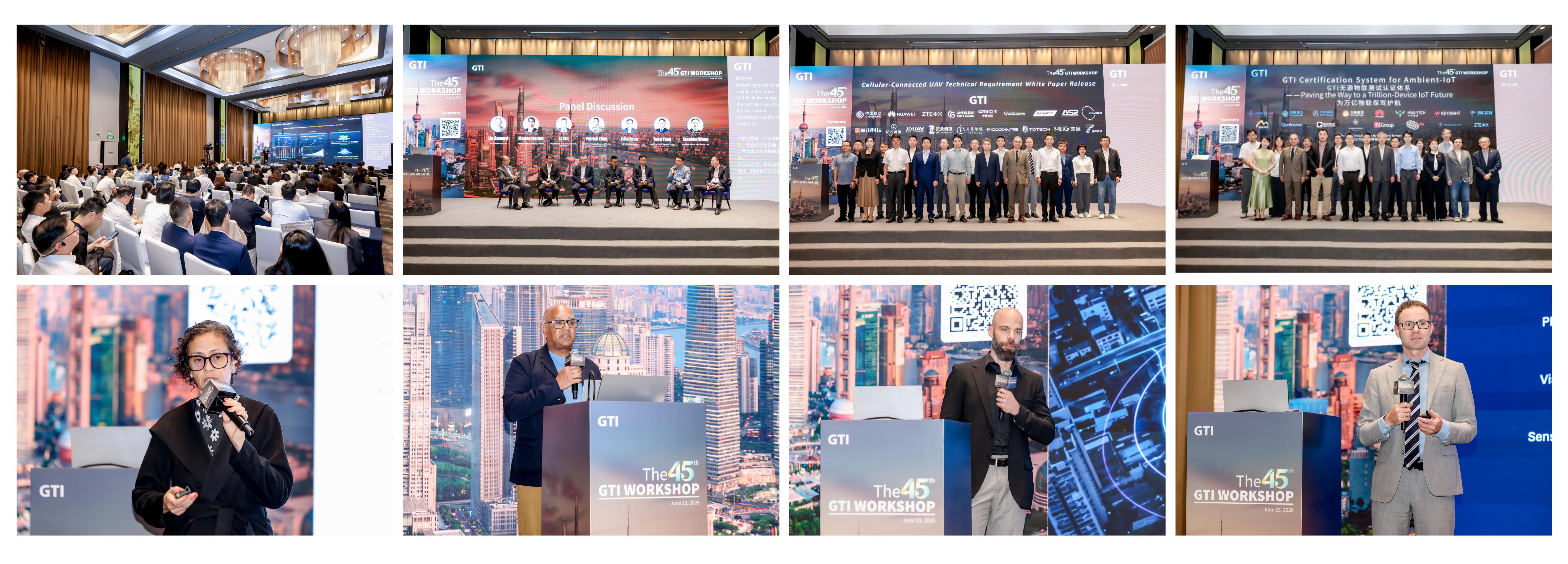
The 45th GTI Workshop was successfully held on June 23 in Shanghai, bringing together over 150 experts from international organizations including GSMA and 3GPP, operators such as STC and HKT, academic institutions like the Hong Kong University of Science and Technology, and industry partners including Ericsson, Qualcomm, Sensoryx, and Omdia. In-depth discussions were conducted across key areas such as network evolution, network-AI integration, 6G spectrum, and 6G testbeds. Huang Yuhong, Secretary General of GTI, delivered remarks and reaffirmed GTI’s commitment to deepening network-intelligence convergence, strengthening global industrial collaboration by leveraging open labs and testing schemes, and jointly advancing innovative development in Mobile AI domain.
In the field of network development, experts shared insights on intelligent connectivity, integrated space-terrestrial networks, and coordinated network evolution. Presentations covered end-to-end low-cost solutions, emerging trends in mobile-AI integration, and new applications. low-altitude communication, ATG, and NTN are also discussed. During the session, partners of 5G/6G program released several white papers, including the 5G-A Super Uplink Technology Evolution White Paper, the Digital and Intelligent Site Technology White Paper, and the Low-Altitude UAV Cellular Module Technology White Paper. These outputs aim to enhance network capabilities to support new intelligent services, promote integrated space-air-ground coverage, and drive end-to-end product innovation.
In the area of network and AI convergence, partners of 5G-A×AI development program presented recent advances in agent protocols and new calling services. Multiple GTI members jointly released the Mobile Communication Network Agent Protocol White Paper, which proposes four core concepts and a six-dimensional capability framework for agent protocols in mobile networks. This white paper serves as a technical reference for standardization, interoperability, and industrial coordination, helping to transform communication networks from "pipe-based connectivity" toward "intelligent service hubs." In addition, live demonstrations of personal call assistants and AI-based voice noise reduction showcased the latest achievements in deep integration between real-time communication networks and artificial intelligence.
In the sector of industry private networks, on-site speakers focused on 5G industry private networks and ambient IoT, engaging in thorough discussions on critical use cases, business value, capability evolution pathways, and scalable replication models. The 5G ENS program released intelligent solutions for manufacturing, supply chain, and healthcare based on ambient IoT, as well as lightweight solutions for access management and traceability, cellular passive IoT base stations, and ambient IoT terminal testing and certification scheme. These outcomes are expected to accelerate technology deployment and industrial development of 5G private networks and ambient IoT, facilitating the digital and intelligent upgrade of various industries.
In the domain of digital intelligent living, participants discussed three core challenges in commercializing home AI agents—scalable mass production, long-term user value operation, and sustainable revenue models, aimed at removing bottlenecks in home AI agent adoption, fostering collaborative innovation across the industrial chain, and accelerating large-scale commercial deployment of home intelligent agents.
Furthermore, GTI also held a dedicated 6G session for the first time, focusing on two key topics in 6G development. The first topic of 6G session is 6G spectrum, presentations highlighted spectrum requirements, the current status of candidate bands, and 6G spectrum planning in major countries, providing a reference for future global coordination. The other topic of 6G session is 6G testbeds, experts introduced the overall architecture of 6G testbeds and presented testing results in integrated sensing and communication scenario. Cutting-edge technical approaches—including AI-native RAN, terminal-side sensing, intelligent terminals, and 6G testing devices—were also shared. In-depth panel explored how to leverage 6G testbeds to advance technology verification and industry maturation.
Going forward, GTI will continue to accelerate industry development by conducting joint experiments on frontier technologies, fostering Mobile AI cross-domain collaboration, and promoting a smooth evolution from 5G-A to 6G.
For presentation of GTI workshops, please Click Here.
For previous meeting page, please Click Here.